


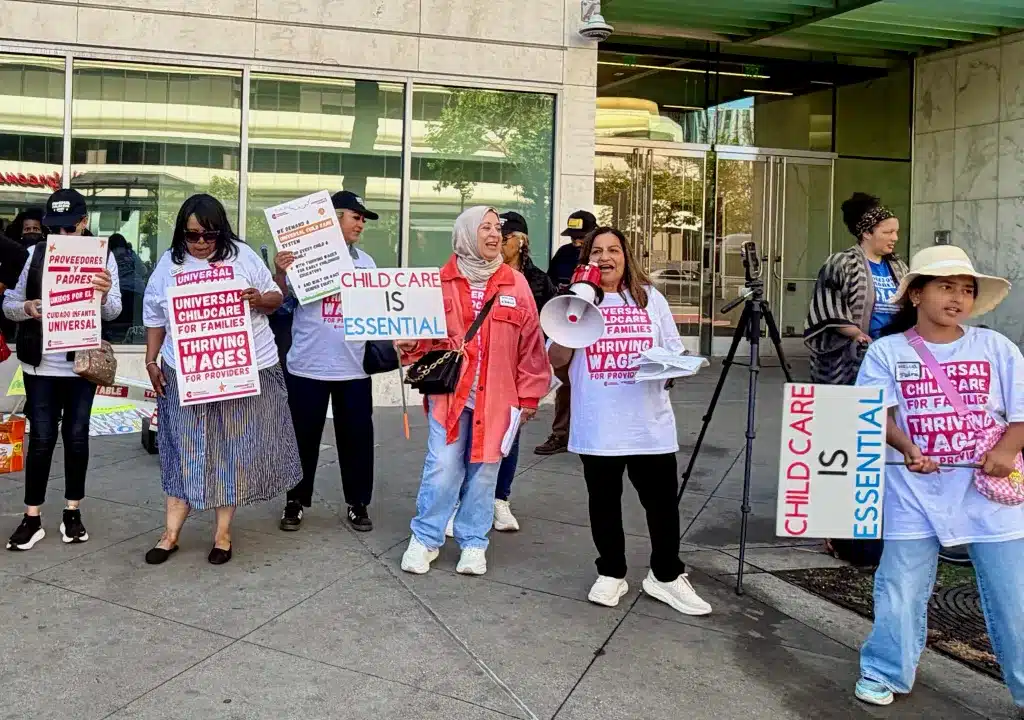
Early childhood educators and supporters rallied in downtown Oakland on Monday to raise awareness about precarity in the industry.
by Ashley McBride
May 11, 2026, 4:00 p.m.
In California, childcare workers, those who teach and care for the state’s youngest residents, earn a median wage of less than $16 an hour.
That’s half as much as elementary and middle school teachers’ median salaries, and $10 below the median wage for all workers in the state, according to the UC Berkeley’s Center for the Study of Childcare Employment.
Those low wages, for work that one advocate calls “the backbone of our country,” are just one concern childcare providers and advocates called attention to during a “Day Without Childcare” on Monday, when some childcare providers chose to shut their doors and participate in a one-day strike. The group gathered in downtown Oakland Monday morning for the fifth annual day of action, with signs and chants about issues such as the low wages for caregivers and high costs for parents and providers.
“Childcare is collapsing,” said Benu Chhabra, CEO of Benu’s Preschool in Concord. “Parents can’t afford it. Providers make really low wages even though we hold degrees in our field. We’re struggling to find employees.”
Chhabra and others are calling for universal childcare, with more government investment so that every family has access to affordable childcare, Chhabra said.
The demonstration took place at 1330 Broadway, in front of a building purchased by the private equity firm KKR in 2021, to highlight private equity’s influence in the early childcare industry. The firm purchased the chain KinderCare in 1996 for half a billion dollars and sold it for twice that amount in 2005. Eight of 11 largest childcare providers in the U.S. are owned by private equity, according to The Economist.
In Alameda County, the childcare industry is a complex system: there are family childcare centers traditionally operated out of a home; larger, more institutional childcare centers; family, friend, and neighbor providers; and public providers such as Head Start and public schools.
Alameda County’s Measure C is a step in the right direction toward providing relief to the industry, advocates said. After a yearslong legal battle, Measure C, a sales tax proposal passed in 2020, recently began providing grants to early childcare providers in the county. Charlotte Guinn, the owner of Rose’s Daycare in West Oakland, said she received a $50,000 grant from Measure C last year.
“That allowed me to repair a railing, build a nursery, and take in three infants that I didn’t have [room for],” she told The Oaklandside. “I could buy resources for those infants, infant toys, and I put up gates.”
Annie Banks, a family organizer for Parent Voices Oakland, called attention to proposals from the Trump Administration that could cap federal childcare subsidies for low-income families and the administration’s immigration enforcement actions near childcare centers, which have prompted fears among both workers and families. She also spoke about the insufficient number of subsidized childcare slots for families in need. Only 16% of eligible families receive childcare subsidies in California, Banks said.
“There are millions of families in California waiting for childcare,” Banks said. “They can’t wait any longer, and there are providers waiting too. Funding childcare spaces would not just expand care for families, it would make sure providers who are small business owners can rely on stable income.”